

At night, your plants are doing some serious work while you sleep. They’re respiring—breaking down roughly 30 to 50 percent of the sugars they made yesterday to fuel cell division and expansion. Think of it like their construction crew clocking in for the night shift.
Darkness actually triggers specific growth-promoting proteins that make stems elongate faster than they would during daylight hours. At the same time, roots are pulling in nutrients with real intensity while starch reserves get converted into energy the plant can actually use. It’s a coordinated effort that happens because light isn’t available to power photosynthesis.
By morning, your plants have positioned their chloroplasts and built up the energy reserves they need to photosynthesize efficiently when the sun comes back. This is why darkness matters just as much as light for solid, healthy growth. Skimping on good darkness—like keeping lights on 24/7—actually slows down the processes that build stronger plants.
Plants Respire at Night to Unlock Stored Energy
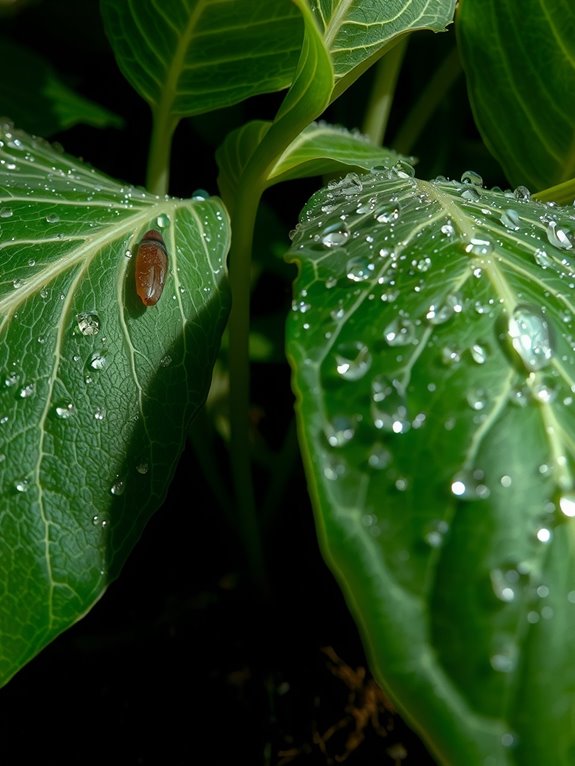
Even when darkness covers your garden, your plants aren’t resting—they’re actively working through the night. While photosynthesis stops without sunlight, your plants shift into respiration mode, burning through stored carbohydrates to power their cells. Think of it like withdrawing money from a savings account to pay your bills.
Here’s what happens: your plants breathe in oxygen and release carbon dioxide all night long, consuming roughly 30-50% of the sugars they made during the day. This nighttime activity fuels everything from root growth to cell repair and new leaf development. The process works because plants need energy for tasks that don’t require light—things like moving nutrients through their tissues and building new cell walls.
Without this nighttime respiration, your plants couldn’t actually grow, even with perfect daytime photosynthesis. The carbohydrates made from sunlight need to be broken down into usable energy, and that breakdown happens when the sun goes down. Your plants are essentially converting yesterday’s captured sunlight into tonight’s growth, getting ready for another day of photosynthesis once the sun rises again.
Nighttime Respiration Powers Cell Division
Your plants don’t just burn energy at night—they’re actually putting that energy to work building themselves bigger and stronger through cell division. When respiration breaks down those starch reserves you watched accumulate during the day, you’re looking at the fuel that powers real growth happening right now. Your plant’s cells are actively dividing and expanding while you sleep, stretching upward as they redistribute resources toward vertical development.
This nighttime respiration operates on a schedule set by your plant’s internal clock, timing cell division for when energy is most abundant and growth demands peak. It’s not wasteful—it’s deliberate. Your plant invests those carbohydrates strategically, channeling them into cellular construction that makes tomorrow’s plant noticeably taller and more robust than today’s version.
The math here is straightforward: a plant growing an inch per week during the active season is doing much of that work during the 8 to 12 hours of darkness. Those respiration rates spike at night, consuming stored glucose and sucrose to fuel the actual building blocks of growth. By morning, you’re not just seeing a plant that photosynthesized yesterday—you’re seeing one that constructed new cells while resting.
The Evening Complex: A Molecular Growth Brake
Your plant doesn’t simply flip a switch and start growing at full speed once darkness arrives. There’s actually a molecular bouncer at work called the Evening Complex, made up of three proteins: ELF3, ELF4, and LUX. Think of it as your plant’s growth brake. This protein trio works together to silence growth-promoting genes like PIF4, deliberately holding back stem elongation during times when conditions aren’t right for expanding.
As evening fades and the Evening Complex weakens, PIF4 activity kicks back in, releasing that brake and accelerating growth. Without this timing mechanism, your plant would elongate haphazardly and flower before reaching the right size. The Evening Complex keeps your plant on a schedule, coordinating nighttime expansion with periods when energy’s actually available to support that growth. The proteins work by binding to DNA and blocking PIF4 expression—a straightforward chemical on-off switch that prevents wasted growth during unsuitable conditions.
Stem Elongation Accelerates When Evening Complex Levels Drop

As evening deepens and the Evening Complex weakens, your plant’s growth shifts dramatically. Think of the Evening Complex as a brake pedal—when it loosens its grip, PIF4, the growth-promoting gene held in check, suddenly activates and springs into high gear. With Evening Complex levels dropping, PIF4 triggers stem elongation that accelerates noticeably during late-night hours.
Your plant stretches upward most during these nighttime hours because that’s when water and nutrient uptake peaks. The circadian clock coordinates this nighttime growth surge with precision, timing stem elongation when conditions naturally favor maximum nutrient flow. The plant isn’t growing randomly; it’s responding to when the conditions actually support that rapid expansion most effectively.
How Starch Breakdown Fuels Night Growth
During the day, your plant’s leaves capture sunlight and store energy as starch molecules—basically filling up an internal battery for later use. When night arrives and photosynthesis stops, your plant gets to work breaking down that stored starch into simple sugars that fuel cell expansion and stem elongation. Your plant’s internal clock controls this perfectly timed energy release, which is why the most noticeable growth happens during those quiet nighttime hours when everything else is still.
Think of it this way: starch acts like a long-term energy storage system, while the simple sugars released at night provide immediate fuel for growth. This two-part system lets your plant keep building even when the sun goes down. The sugars move through the plant’s vascular tissues and power the processes that lengthen stems and expand cells, letting your plant literally grow taller and fuller while you sleep.
Starch Accumulation During Day
How do plants keep growing when the sun disappears? During daylight hours, your plants work like power-storing machines, busy photosynthesizing and capturing sunlight to convert into glucose. They then transform this glucose into starch, storing it in their leaves for later use.
Think of starch as your plant’s savings account. Your plant’s circadian clock—that internal 24-hour timer—carefully orchestrates how much starch builds up throughout the day. This timing matters because it makes sure you have enough energy reserves ready for the nighttime hours ahead.
Here’s where plants get smart: they don’t just randomly stockpile starch without thinking. Instead, they calculate how long the night will be and adjust their starch accumulation accordingly. This means the stored energy can be used steadily through the darkness without the plant running out of fuel before sunrise arrives. That stored starch becomes the building blocks for tomorrow’s new growth.
Nocturnal Energy Release Mechanisms
As darkness falls, your plant switches from storage mode to spending mode. Starch degradation kicks into gear, breaking down the carbohydrates you helped accumulate during daylight hours. Your plant’s circadian regulation acts like an internal alarm clock, timing this breakdown for maximum efficiency. Think of it as withdrawing energy from a savings account right when you need it most.
Those released sugars fuel growth processes, with peak expansion happening late at night and early morning. The circadian clock coordinates everything by aligning gene expression with starch-derived energy availability. Your plant isn’t just resting at night. It’s strategically using stored resources to stretch taller and develop stronger.
The timing matters more than you might think. When starch breaks down around midnight to 3 AM, your plant mobilizes those sugars toward cell elongation and structural development. This happens because the plant’s internal clock signals that energy is available and growth conditions are favorable. The sugars move through your plant’s tissues, building new cells in the stems and leaves. By the time daylight returns, your plant has already invested several hours of growth that you’ll actually see when you check on it in the morning.
Growth Acceleration After Breakdown
Once starch breakdown kicks in around midnight, your plant suddenly has fuel to work with. Through starch degradation, those stored energy molecules convert into simple sugars—glucose and sucrose primarily—that power nighttime growth. Your plant channels these sugars directly into stem elongation and biomass accumulation rather than wasting them sitting idle.
This growth acceleration happens because your plant’s circadian clock coordinates everything with precision. The evening complex activates growth-promoting factors like PIF4 and PIF5, which basically signal your plant that conditions favor vertical stretching. When starch breakdown aligns with these hormone signals, you get efficient energy-to-growth conversion working in your favor.
During dark hours, your plant grows vertically and stretches toward potential light sources while photosynthesis takes a break. This nighttime growth represents your plant’s most productive window for vertical development, which is why seedlings grown without adequate darkness tend to stay stubby and compact. The combination of available sugars and hormonal timing means your plant can build new cells faster than it could during the day when energy gets split between multiple processes.
How Circadian Clocks Time Growth to Energy Availability
Plants don’t actually shut down when darkness falls—they’re running a carefully timed operation that would make any strategist proud. Your plant’s circadian clock acts like a master scheduler, deciding exactly when growth should happen based on what energy is available. Clock genes including CCA1, LHY, and TOC1 work as controllers in this system, managing when stem cells expand by regulating PIF proteins and triggering starch breakdown. Rather than burning through stored energy haphazardly, plants coordinate their growth timing with nighttime starch reserves, which means stem elongation peaks when fuel is genuinely abundant. This synchronization allows your plant to stretch taller during the hours when energy actually supports that expansion, rather than wasting resources on growth when nothing backs it up.
Starch Metabolism and Growth Timing
Plants grow on a schedule that’s tied directly to their energy supply, and it’s more predictable than you might think. During daylight hours, photosynthesis fills their cells with starch—basically stored sugar that acts like a battery. When darkness falls, plants don’t just sit idle. Instead, they activate growth programs that pull from those starch reserves at precisely the right moment.
The protein PIF4 acts as a timer, switching on late-night growth when starch breakdown is at its peak. This coordination between energy release and cell expansion prevents your plant from running its fuel tank empty before sunrise. Growth happens during the plant’s equivalent of payday, when degrading starch floods cells with glucose and other usable sugars.
Think of it like your own budget. You wouldn’t spend money fastest when your account is lowest. Your plant works the same way—it elongates and expands cells when energy is most available, then scales back activity as dawn approaches. This careful timing between starch metabolism and growth keeps your plant from overextending itself and facing an energy shortage when it needs to photosynthesize again.
Clock Genes Gate Growth Cycles
The precision we’ve just explored—where plants spend their starch reserves exactly when energy floods their cells—doesn’t happen by accident. Your plant’s circadian clock orchestrates this perfect timing, coordinating growth with energy availability throughout the day-night cycle.
Think of your plant’s internal clock as a master scheduler that works with growth regulators to decide when stems lengthen. Several key clock genes manage this process. PIF4 activation drives nighttime stem stretching when cooler temperatures and darkness create conditions that favor elongation. ELF3 acts as evening brakes, holding back premature growth before the plant has mobilized enough starch reserves. CCA1 and LHY establish morning checkpoints where the plant assesses whether current light and energy levels support growth. TOC1 maintains the rhythmic cycling of all these genes throughout the 24-hour day. Meanwhile, CSN pathways control how quickly the plant breaks down and rebuilds clock proteins, keeping the whole system running smoothly.
Your plant doesn’t grow randomly throughout the day and night. Instead, it times peak elongation when starch mobilizes and energy peaks, usually during early morning hours when light returns but temperatures remain cool. This gating mechanism means growth happens strategically during windows when the plant has both the energy available and the right environmental cues to support it, which maximizes the plant’s survival chances in its actual growing conditions.
Water Uptake and Transpiration Shift During Darkness
When darkness falls, your garden doesn’t simply switch off—it shifts into a different operating mode. Nighttime water uptake continues at a slower pace than daytime demands because photosynthesis halts without sunlight, reducing your plants’ overall water needs.
Here’s where the biology gets interesting: less than 2% of nighttime water escapes through transpiration. Your plants keep their stomata mostly closed at night, which protects them from excessive water loss. However, they don’t seal up completely since some stomata remain slightly open for gas exchange, allowing oxygen and carbon dioxide to move in and out.
That partial opening matters more than you might think. Even in darkness, transpirational pull still works, drawing water upward from roots to leaves. This gentle movement maintains cell turgidity—that firm, plump quality that keeps plant tissues from wilting—and helps cool your plants through the night. Your garden’s nighttime strategy balances water conservation with staying hydrated and comfortable, using significantly less moisture than it demands during daylight hours.
Auxin and Gibberellins Drive Nocturnal Growth
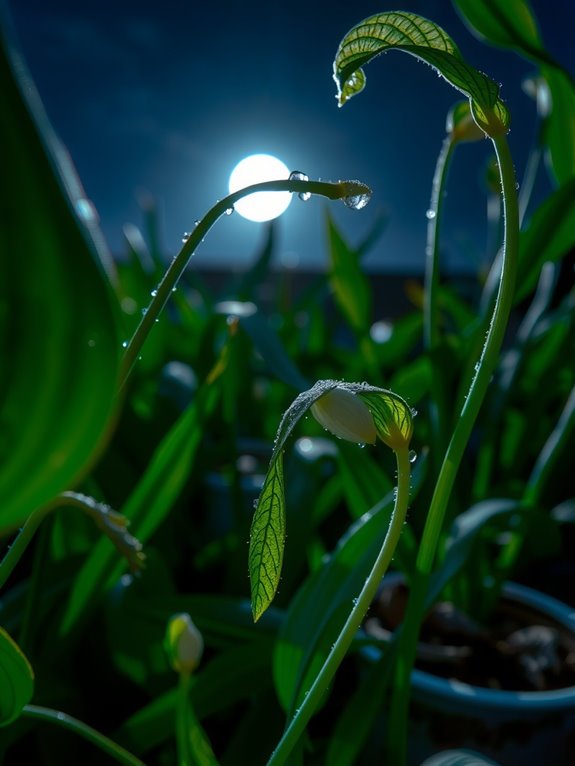
While your plants rest from photosynthesis, two powerful hormones—auxin and gibberellins—actually kick into high gear, orchestrating a growth spurt you can’t see happening. These hormones work together during darkness in ways that directly affect how tall and full your plants become.
When night falls, gibberellins activate growth pathways that coordinate stem elongation without photosynthesis running. At the same time, auxin redistributes unevenly across your plant tissues, causing cells on one side to elongate more than the other—this differential growth is what makes stems stretch upward. The two hormones essentially tag-team this process, with gibberellins providing the growth signal and auxin directing where that growth happens most intensely.
Your plant’s circadian rhythms time these hormone surges for maximum efficiency, meaning the timing of nocturnal growth isn’t random but genetically programmed. Starch stored during the day gets mobilized at night to fuel this expansion, so your plant’s energy budget works out neatly. When auxin transport functions properly and gibberellin signaling stays intact, you’ll notice measurable stem elongation—often 1 to 3 millimeters per night depending on the species.
Disruptions in either hormone’s movement or signaling dampen this nighttime growth noticeably. Poor light conditions, temperature stress, or physical damage to stems can all interfere with auxin distribution and gibberellin production, slowing elongation considerably. This matters because your plant evolved to grow when energy demands are lowest and darkness prevents the cell damage that intense light can cause to expanding tissues.
Etiolation: Seedling Responses to Darkness
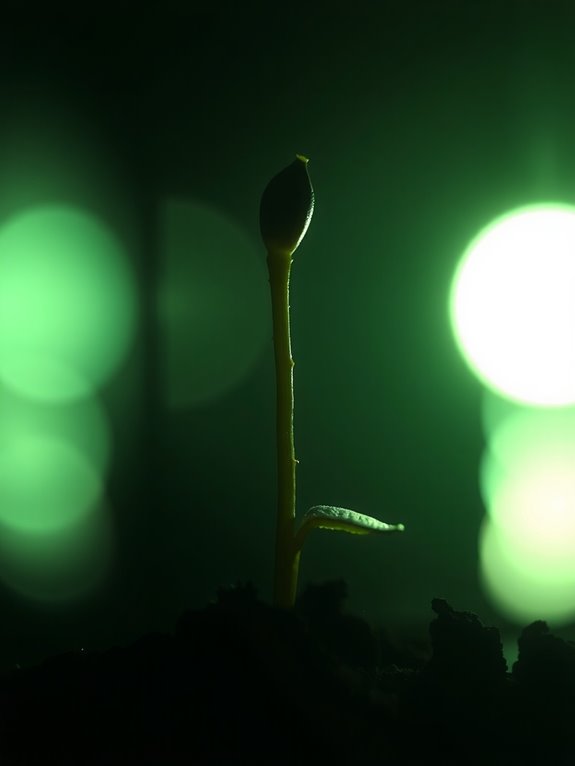
When you keep a seedling in complete darkness, it stretches itself thin with an elongated hypocotyl and hooks its cotyledons upward—a survival strategy called etiolation. This happens because your plant’s molecular machinery shifts into search mode, looking for light sources that might be blocking it from above.
Here’s what’s happening inside the plant cells: PIF transcription factors activate over 2,000 genes to fuel rapid stem growth, while COP1 and DET1 proteins suppress light-sensing signals by breaking down HY5, a protein that normally promotes healthy, compact growth. Think of it like your seedling has put on blinders and hit the accelerator, burning through energy reserves to elongate rather than build leaves.
The moment you expose that etiolated seedling to light, the whole system flips dramatically. Light destroys the PIF factors that were driving the stretch and stabilizes HY5 instead. Within hours to days, your plant shifts from elongation mode into de-etiolation—the process where it stops stretching and starts building sturdy, thick stems and developing actual leaves capable of photosynthesis.
This response reveals something practical about seedling care: seedlings need light early and consistently to grow properly shaped. If your indoor seedlings look pale, spindly, and reaching toward a window, they’re etiolating and telling you they’re not getting enough light intensity or duration. Moving them under a grow light positioned 4 to 6 inches above the seedlings prevents this wasted growth and produces compact, healthy plants ready for transplanting.
Dark-Induced Growth Features
How do seedlings actually know they’re sitting in the dark? They rely on PIF transcription factors—specialized proteins that activate when light disappears. These PIFs trigger etiolation, a survival strategy that reshapes your seedling dramatically.
When darkness sets in, your seedling undergoes several specific changes. The hypocotyl stretches upward, sometimes growing 2-3 times faster than it would in light, as the plant searches for any light source above. The cotyledons curl into a protective hook shape, shielding the delicate leaves underneath as the seedling pushes through soil. Meanwhile, chloroplasts remain dormant and colorless without light to activate them. Your seedling redirects over 2,000 genes’ worth of biological effort toward rapid stem growth rather than leaf expansion or making chlorophyll.
What’s really happening here is resource management. Your seedling is running a calculated sprint in darkness, conserving energy while betting it’ll reach light soon. It won’t waste precious sugars and nutrients making chlorophyll or expanding leaves until sunlight actually shows up. The plant essentially gambles that this dormant period won’t last long. It’s botanical efficiency—the seedling grows tall and spindly on purpose, not as a sign something’s wrong, but as its best shot at survival in poor lighting conditions.
Light-Dependent De-Etiolation Process
The moment your seedling detects light, a cascade of chemical signals floods through its cells, flipping its developmental switch. Those PIF transcription factors that promoted stem elongation in darkness get broken down rapidly, usually within 1-2 hours of light exposure. This shift happens because light-activated phytochrome proteins trigger a signaling pathway that destabilizes these growth-promoting proteins, sending your seedling an unmistakable message: conditions have changed.
Photomorphogenesis kicks in as your plant recognizes it’s above ground now and adjusts accordingly. The pale, spindly stem starts straightening out, cotyledons (seed leaves) begin expanding, and chloroplasts mature into fully functional organelles capable of photosynthesis. At the same time, the COP/DET/FUS protein complexes that suppressed these developmental changes in darkness finally release their hold on the system.
The physical changes happen fast—within hours you’ll notice your seedling looks noticeably different. The hook at the top of the stem relaxes, allowing the first true leaves to unfold more easily. Chlorophyll production ramps up, shifting the plant from pale yellow-green to deeper green as it gathers energy from light. This de-etiolation process represents your plant pivoting from survival mode (stretching for any available light underground) to growth mode (building the structures it actually needs to thrive above ground).
Molecular Regulators of Darkness
When darkness settles around your seedling, a different set of molecular actors takes over the stage. PIF transcription factors activate and flip the growth switch, controlling more than 2,000 genes that drive etiolation—that characteristic stretching and hook formation buried seeds develop. Your seedling doesn’t resist the darkness; instead, it commits to a strategic survival approach.
Three main molecular players coordinate this underground response. DET1 keeps PIF proteins stable and active, COP1 suppresses light-promoting factors while darkness persists, and HY5 remains shut down without light signals to activate it. Meanwhile, etioplasts begin developing in place of mature chloroplasts, and the seedling channels its energy toward rapid elongation rather than photosynthesis.
This response makes practical sense when you consider the seedling’s actual problem: it needs to reach the soil surface before its stored energy runs out. Growing fast straight up beats growing slowly with green leaves underground where no light reaches anyway. The molecular machinery essentially gambles that light exists somewhere above, and speeds toward it accordingly. Once the seedling breaks through soil and light hits those phytochromes, the entire system reverses course—PIF factors get suppressed, growth slows down, and chloroplast development accelerates instead.
PIF Genes Drive Growth When Evening Complex Levels Drop
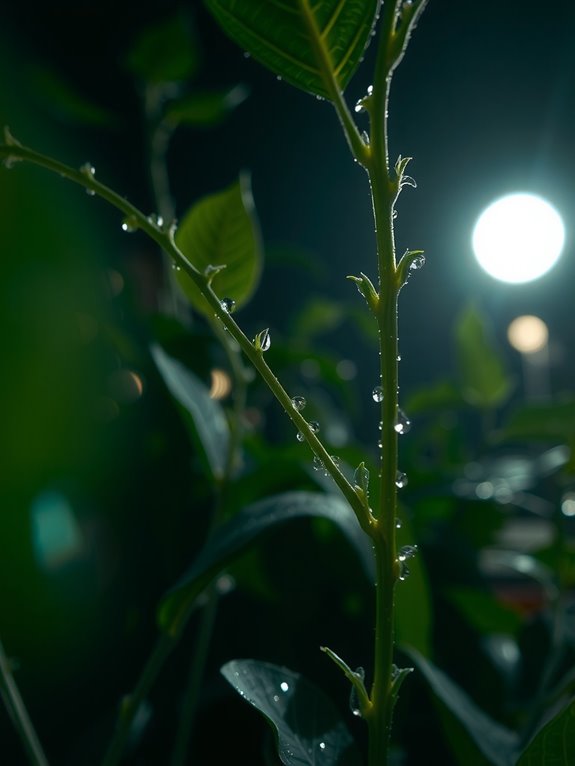
As evening descends and the Evening Complex’s grip loosens, PIF4 and PIF5 genes spring into action. That’s when your plant really starts stretching. Think of the Evening Complex as your plant’s nighttime brake pedal. When it’s active during evening hours, it clamps down on PIF4 and PIF5, keeping growth in check.
The Evening Complex acts as your plant’s nighttime brake pedal, clamping down on PIF4 and PIF5 to keep growth in check during evening hours.
Here’s where it gets interesting: as those Evening Complex levels drop, the brakes release entirely. PIF4 and PIF5 surge forward, triggering rapid stem elongation when darkness deepens. Your plant isn’t sitting idle at night—it’s strategically extending upward to chase light sources.
This happens because plants can’t move around like animals do, so they adapt by growing toward potential light. When your plant senses shade or approaching darkness, it knows the smart move is to get taller before competition really heats up. The coordinated dance between these molecular regulators means growth happens when your plant can actually use that energy efficiently, rather than wasting resources during the brightest part of the day when photosynthesis works best.
Understanding this mechanism helps you appreciate how nighttime growth works at the cellular level. When you dim lights by 20 percent or increase shade cloth coverage, you’re essentially mimicking the conditions that flip this switch. This knowledge gives you real control over how tall your plants grow indoors or in a greenhouse setting, rather than just hoping they cooperate.
Root Development Surges After Dark

Just when your plant’s shoots are stretching skyward in the darkness, something equally important happens underground. Your plant’s root growth actually surges after dark, tapping into nocturnal energy reserves accumulated during daylight hours.
During those nighttime hours, your plant redirects resources downward instead of wasting energy on photosynthesis in complete darkness. Stored starch converts to usable sugars that fuel root cell elongation, allowing roots to push deeper into the soil. Transpirational cooling maintains the turgor pressure—that internal plant firmness—which roots need to expand and elongate effectively. Water continues moving through the plant’s vascular system uninterrupted, supporting this underground expansion without competition from daytime photosynthetic demands.
Your plant’s circadian networks, those internal biological clocks, coordinate when roots absorb nutrients with soil availability patterns. Mineral absorption intensifies during active root extension, meaning phosphorus uptake for root development and potassium for cell strength happen more efficiently at night. This nighttime strategy establishes stronger root foundations and improved nutrient access for the weeks ahead.
You’re essentially watching your plant’s underground infrastructure build itself while you sleep, maximizing growth efficiency through intelligent energy allocation. This is why plants with consistent 12-to-16-hour dark periods typically develop more robust root systems than those with irregular light schedules.
Night-Blooming Plants: Timing Reproduction to Pollinator Activity
Have you ever wondered why some flowers seem to save their best performance for after sunset? Night-blooming plants like evening primrose and yucca flowers have figured out how to time their reproduction with nocturnal pollinators through photoperiodism—a biological response to light cycles that controls when they flower. You’ll notice these plants display pale or white petals and emit strong fragrances, which makes them visible and attractive to moths, hawkmoths, and bats hunting in darkness.
This synchronization isn’t random at all. It’s the result of finely tuned evolution. These flowers have already harvested sunlight energy during the day, so they can open and release their scent at night without needing to photosynthesize. The pale coloring reflects moonlight and starlight, making the blooms easy to spot from a distance of 10 to 20 feet away for flying pollinators. The fragrances, which can be detected from 50 feet or more, act like a beacon drawing insects and mammals directly to the nectar.
Urban artificial lighting increasingly disrupts this delicate timing, though. When streetlights, porch lights, and building illumination stay on all night, they can confuse the plants’ internal clocks and throw off the alignment between blooms and pollinator activity. A flower that opens at midnight expecting to attract hawkmoths might miss them entirely if artificial light makes the plant think it’s still dusk. This mismatch between plant schedules and pollinator availability reduces the chances of successful pollination, which means fewer seeds and less reproduction for the next generation. Protecting the nighttime environment from light pollution helps keep these natural partnerships working the way they’ve evolved to work.
How Light Pollution Disrupts Growth Cycles
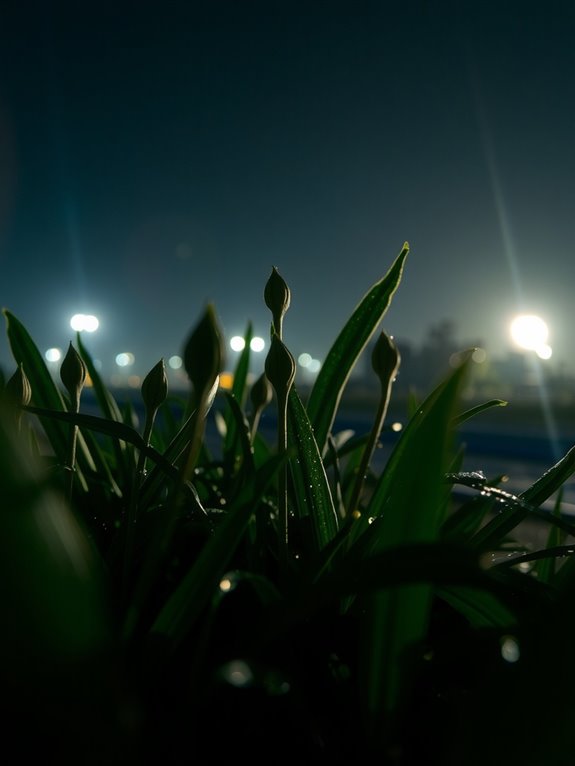
When you flip on your porch light at dusk, you’re not just illuminating your yard—you’re sending confusing signals deep into the plants growing nearby. Your nighttime lights disrupt the circadian regulation that orchestrates healthy growth cycles.
Plants rely on darkness to know when to rest. Their photoreceptors can’t tell the difference between your porch light and sunset, so they keep growing when they should be winding down. Two specific growth proteins, PIF4 and PIF5, are supposed to activate at night and tell the plant to slow down. But with artificial light around, these brakes fail to engage properly. The plant stays in growth mode, exhausting its resources and leaving itself vulnerable when frost arrives.
The ripple effects go further than you might expect. Flowers bloom at the wrong time of year, missing their natural pollinator schedules. The plant’s internal timing for allocating energy gets scrambled, disrupting the late-night growth surges that normally happen. All of this adds up to winter injury, weakened plants, and less reliable blooming.
The good news is that you can work with your plants’ natural clocks instead of against them. Dimming outdoor lights after dark makes a real difference, or you could switch to amber-wavelength bulbs (around 2200 Kelvin color temperature) that plants are less sensitive to. Even moving a light source farther from your garden beds reduces the disruption. Your plants will respect their own biological clocks and handle the seasons much better when they get the darkness they need.
Overnight Chloroplast Prep Fuels Dawn Photosynthesis
During the night, your plant’s chloroplasts aren’t actually sleeping—they’re preparing for tomorrow’s photosynthesis by breaking down starch reserves stored in the leaves. Think of it as a midnight fuel delivery: those starch molecules split into glucose and other simple sugars that will power the light reactions as soon as dawn arrives. By sunrise, your plant’s chloroplasts are primed and ready after spending the night converting yesterday’s captured light energy into the exact molecules needed to start photosynthesizing efficiently.
Here’s what’s actually happening at the molecular level. Your leaves store starch during the day as a way to bank the energy from photosynthesis. When darkness falls and light reactions stop, enzymes begin breaking down those starch chains into glucose molecules about 15-30 micrometers in size that can move through the plant’s cells more easily. This glucose doesn’t just sit around—it gets used right away for the plant’s own growth and cellular maintenance throughout the night. By the time light returns, the plant has already mobilized fresh sugar supplies positioned exactly where they’re needed for immediate photosynthetic activity.
Starch Mobilization at Night
While you’re sleeping, your plant is busy managing its energy accounts through starch mobilization. During the day, photosynthesis stuffs chloroplasts full of starch—basically storing carbohydrates for later use. When darkness falls, your plant shifts into withdrawal mode, breaking down that stored starch into usable sugars throughout the night.
Think of it like your plant’s personal savings account. Your plant can’t photosynthesize without light, so it relies on these nighttime sugar releases to fuel respiration and basic maintenance. The process works on a circadian rhythm, meaning your plant’s internal clock controls exactly when and how fast starch gets broken down.
Here’s the sequence of what actually happens: starch molecules in chloroplasts get systematically dismantled into glucose and other sugars through enzymatic breakdown. These sugars move throughout the plant tissue, providing energy for cellular respiration—essentially the plant’s way of staying alive when photosynthesis isn’t possible. The circadian clock times this breakdown carefully, releasing sugars at a steady pace rather than all at once.
When morning light returns, your plant immediately ramps up ATP production, which is cellular energy used for growth and photosynthesis. Because starch was properly depleted overnight, your plant starts the day with metabolic momentum rather than sluggish energy reserves. This timing reduces the amount of carbon your plant loses as respiratory waste, preserving more energy for actual growth.
Disrupting this natural cycle through inconsistent lighting—like leaving grow lights on unpredictably or moving plants between bright and dim spaces—confuses your plant’s internal timing. When starch breakdown gets out of sync with actual light availability, your plant either wastes sugars through excess respiration or lacks fuel when it needs it most. Respecting your plant’s circadian preferences by maintaining consistent day-night cycles supports stronger morning vigor and more efficient carbon use overall.
Dawn Photosynthetic Readiness
Your plant’s chloroplasts don’t actually sleep—they’re preparing for sunrise like an athlete stretching before competition. Throughout the night, your plant’s circadian clock orchestrates a prep routine that sets the stage for photosynthesis at dawn.
Here’s what happens in those quiet hours. Your chloroplasts maintain energized electron transport chains and keep ATP and NADPH pools stocked overnight, holding these energy molecules ready for immediate use when light arrives. Mesophyll cells stockpile carbohydrates and reducing equivalents that will fuel the Calvin cycle the moment sunlight hits. Your plant’s internal clock also triggers photosynthetic enzyme production just before sunrise, timing gene transcription so everything’s positioned perfectly.
The stomata mostly stay closed during these hours, which conserves water while allowing minimal gas exchange. When sunlight finally hits, your plant transitions instantly to net photosynthesis without needing any warm-up period. This pre-dawn preparation means your plant can capture and convert light energy right away, rather than wasting those early morning hours getting systems online. That head start makes a real difference in how much sugar your plant produces before midday heat sets in.
Engineer Faster Crops by Modulating Night Growth

What if you could flip a genetic switch and watch your crops bulk up faster? You actually can. Scientists have discovered that adjusting your plant’s circadian clock taps into nighttime growth potential—and the biology behind it is pretty straightforward.
Your plant’s evening complex works like a growth brake. This complex includes three proteins: ELF3, ELF4, and LUX. When these proteins are active, they hold back growth. As evening progresses and their levels drop, two other proteins called PIF4 and PIF5 surge forward, triggering rapid stem elongation. You’re basically releasing the botanical handbrake.
To speed up your crops, focus on these specific optimization points:
Disrupt the brake mechanism. Mutating the ELF3, ELF4, or LUX genes weakens the evening complex’s ability to suppress growth. This gives PIF4 and PIF5 more freedom to work during nighttime hours.
Balance gas signals carefully. Plants regulate growth through hormones like gibberellins and auxins. Adjusting how these compounds move through stems during night hours can amplify elongation without overdoing it.
Match your approach to growing conditions. In nutrient-rich soil, you can push night growth harder because plants have the resources to build new tissue quickly. In nutrient-limited environments, dial back the acceleration to prevent weak, spindly stems that can’t support themselves.
Time growth peaks with resource availability. Cool nighttime temperatures around 55-65°F combined with adequate water and nitrogen create the best conditions for rapid cell elongation. Scheduling irrigation and fertilizer application before peak growth windows maximizes their effect.
Track stem elongation rates. Measure stem diameter and length during late-night hours (around 2-4 AM) when growth accelerates most. A growth rate above 2-3 millimeters per night indicates the system is working well.