Plant growth stalls when you overlook the invisible bottlenecks hiding in your soil and environment. Water that won’t penetrate deeper than a quarter-inch sits uselessly above compacted earth, leaving roots gasping for oxygen while the soil below stays bone-dry. Salt buildup and pH swings lock nutrients away from hungry plants, making food inaccessible even when it’s technically present.
Your plants can simultaneously drown in waterlogged conditions while starving from poor drainage—a frustrating situation that happens more often than you’d think. This happens because water moving through soil needs somewhere to go, and when it gets trapped, roots suffocate.
Light intensity, photoperiod length, and temperature rhythm mismatches also cripple flowering and fruiting. A plant expecting twelve hours of light won’t perform well with eight, and cold snaps at the wrong time derail reproductive cycles.
The real fix starts with foundational soil quality and drainage working together. Break up compacted soil, add organic matter like compost to improve water movement, and test your pH with an inexpensive kit so you know what you’re working with. Balance those three pieces—water flow, oxygen access, and nutrient availability—and you remove the bottlenecks that stop everything cold.
Water Stress: The Most Common Growth Blocker
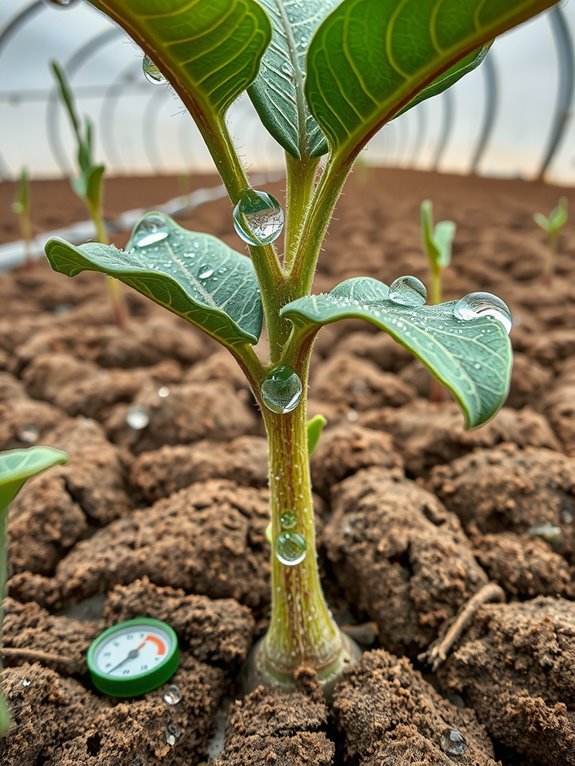
Water acts as the invisible force behind plant growth, and when moisture runs short, your plants simply can’t perform at their best. In the western U.S., you’re probably facing consistently dry conditions throughout the growing season, which makes gardening genuinely harder.
Here’s what actually happens at ground level: rainfall below 0.25 inch typically stays near the surface and doesn’t penetrate deep enough to help your root systems, leaving you watching your plants struggle despite your efforts. Once rain reaches 0.25 inch or more, it actually soaks into the soil meaningfully, giving roots genuine access to the water they need.
The tricky part is that vegetation and mulch sitting on top catch rainfall before it reaches bare soil, which cuts down how much water actually becomes available to your plants. The good news is you have real options to work with. Water harvesting techniques like contour microcatchments and deep watering strategies genuinely improve how far moisture penetrates into your soil, helping your roots dig deeper and establish themselves in zones where drought pressure can’t touch them.
Soil Drainage and Root Suffocation
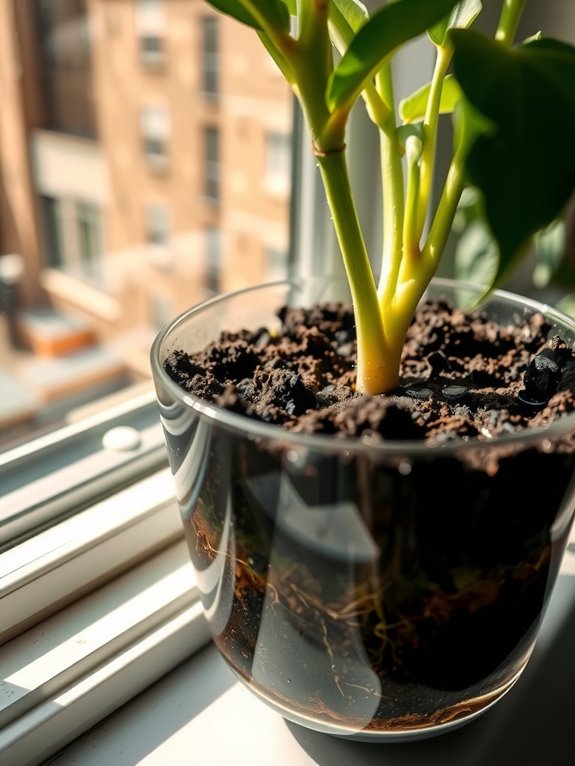
When water gets trapped in soil, your plants’ roots can’t access the oxygen they need to survive and function properly. Heavy, compacted soil eliminates the air pockets roots depend on for respiration, while soggy conditions literally suffocate the root system and prevent nutrient absorption. It’s like trying to breathe underwater—eventually the whole process breaks down.
The problem often comes down to soil structure. Clay-heavy soils compact easily and hold water longer than sandy or loamy mixes, which drain faster and maintain better air circulation around roots. If you squeeze a handful of wet soil from your garden and it forms a tight ball that doesn’t crumble apart, you’re dealing with poor drainage.
Here’s what happens physically: roots sitting in waterlogged soil for more than a few days start to rot because beneficial microorganisms that help plants absorb nutrients need oxygen too. Without air movement through the soil, anaerobic bacteria take over instead, creating toxic compounds that further damage roots. The root system essentially shuts down, unable to pull water and nutrients upward even though the soil is soaking wet.
You can fix this by amending your soil with materials that improve drainage. Mix in 2-4 inches of compost, perlite, or coarse sand into the top 8-12 inches of existing soil to create more pore space. For container plants, use a potting mix with peat moss, perlite, and bark rather than dense garden soil. Raised beds filled with quality growing medium also solve drainage issues completely, since water moves through and down rather than pooling around roots.
Waterlogged Soil And Roots
When soil stays saturated for days after rain or watering, you’re creating an oxygen crisis that suffocates plant roots. Waterlogged soil prevents roots from absorbing the water and nutrients plants need to function properly. The moment oxygen runs short underground, a chain reaction of problems starts unfolding.
| Problem | What Happens | Your Plant’s Response | Timeline |
|---|---|---|---|
| Oxygen Starvation | Roots can’t absorb water or nutrients | Wilting despite wet soil | Hours to days |
| Nutrient Lockup | Uptake shuts down completely | Yellowing leaves appear | Days to weeks |
| Root Rot Risk | Fungi and pathogens thrive in wet conditions | Mushy roots, foul smell | Weeks |
| Growth Halt | Metabolism crashes from stress | Stunted development | Ongoing |
The fix starts with drainage. Raised beds work well because they sit above ground level and shed water naturally. You can also dig a drainage well—basically a hole filled with gravel about 18 inches deep—to catch pooling water. Swapping heavy clay soil for a better-draining mix helps too. Combine your existing soil with perlite or coarse sand at a 3-to-1 ratio to open up air pockets that water can move through. Your roots need to breathe as much as they need water.
Oxygen Deprivation In Growing Media
Picture this: your soil looks moist, feels spongy, and smells a bit off—that’s your first sign that oxygen levels have dropped. When growing media lacks proper drainage, waterlogged conditions suffocate roots by restricting the air they need to function. Your root tips, which are remarkably sensitive to low oxygen environments, can’t access the oxygen required for respiration. This metabolic slowdown directly reduces nutrient uptake and slows plant growth across the board.
Heavy, compacted soil and overwatering create the problem by limiting air-filled porosity in your growing medium. Without those tiny air pockets, gas exchange stops happening around your roots, and things go downhill fast. The fix involves three practical steps: swap dense soil for lighter media like perlite or coarse sand mixed at a 30-40 percent ratio, confirm your pots have drainage holes at least one-quarter inch in diameter, and reduce your watering frequency by checking soil moisture two inches below the surface before watering again.
Better drainage directly increases oxygen availability to roots. This means your root systems stay healthier, plants absorb nutrients more efficiently, and you end up with plants that perform the way you actually want them to perform.
Compacted Soil Structure Problems
Have you ever noticed how water pools on top of soil instead of soaking in? That’s compaction, and it’s seriously limiting what your plants can do.
When soil gets compressed, you’re essentially crushing the pore spaces that normally let water and air move through. Your roots can’t push down deeply, so they’re stuck near the surface where nutrients and moisture run thin. Poor drainage creates soggy conditions that suffocate roots by blocking the oxygen they need to function.
Heavy equipment, repeated foot traffic, and tilling without adding organic matter all compress soil structure over time. The result is surface runoff replacing infiltration, so your plants experience drought stress even when rainfall is adequate.
To fix compaction, you’ll need to aerate your soil, add 2 to 3 inches of mulch, and work in organic matter like compost. Aeration creates those pore spaces again, letting water drain properly and roots reach deeper into the soil where nutrients are more abundant. Mulch protects the surface from further compression while it breaks down and feeds your soil biology. Incorporating 4 to 6 inches of quality compost improves structure significantly and helps soil hold water in a balanced way, rather than either pooling on top or running straight through.
This isn’t a quick fix—it takes a season or two to see real improvement. But once you break that compaction cycle, your plants will respond noticeably as their roots finally have room to grow.
Nitrogen Deficiencies and Weak Growth
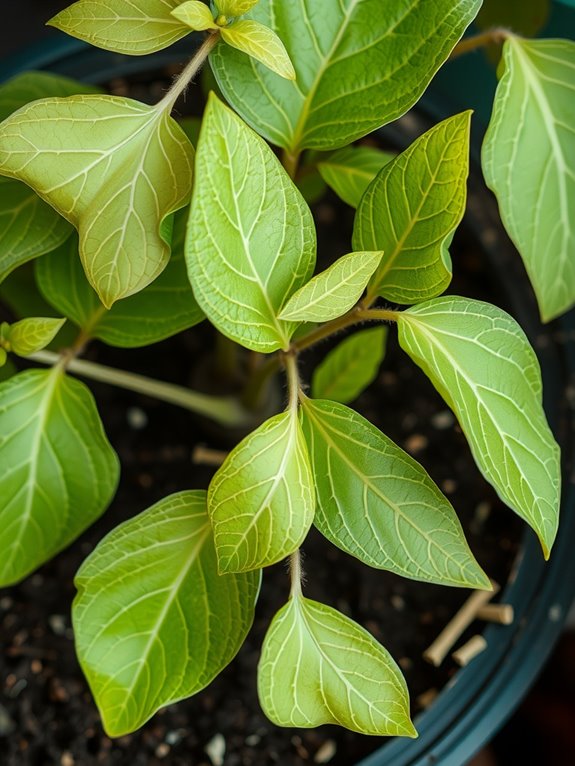
Why do your plants sometimes look pale and spindly despite your best efforts? Nitrogen deficiency is likely the culprit. This essential macronutrient fuels growth, and without enough of it, your plants simply can’t develop properly.
When nitrogen runs low, you’ll notice a few telltale signs. Leaves start turning yellow at the bottom of the plant, then the discoloration creeps upward as the plant pulls nitrogen from its older tissue to support new growth. New shoots come in weak and spindly, unable to support themselves or produce full, healthy leaves. The whole plant stays smaller and develops more slowly than it should.
Here’s what you can do about it. Start by testing your soil—a basic soil test kit from any garden center costs around ten to fifteen dollars and tells you exactly what nitrogen levels you’re working with. Once you confirm the deficiency, add targeted nitrogen through compost, a balanced fertilizer like 10-10-10, or nitrogen-rich amendments such as blood meal or fish emulsion.
Check your plants every week or two as you add nitrogen to the soil. Most plants respond within two to three weeks, showing fresher green color and sturdier new growth. Catching a deficiency early keeps it from becoming a serious problem that stunts your entire garden’s output.
Phosphorus and Potassium: The Overlooked Macronutrients
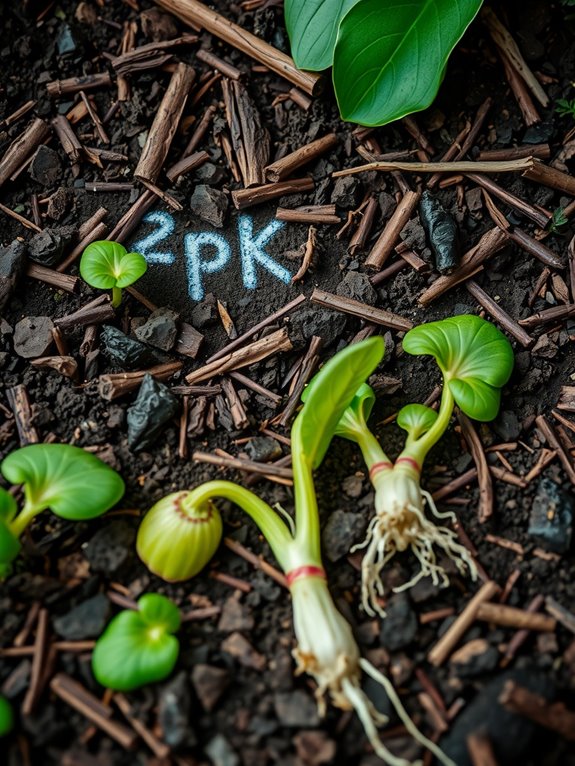
You’ve probably heard about nitrogen, but phosphorus and potassium deserve way more attention because they quietly handle the jobs that keep plants healthy and productive. When phosphorus drops too low, you’ll spot stunted growth and those distinctive purple or reddish leaves that signal nutrient stress. Low potassium shows up differently—weak stems that can’t support the plant’s weight and fruit that stays small or fails to develop properly. Here’s the thing: these nutrients work together as a team, so skipping either one creates a chain reaction that weakens your entire plant. A balanced approach matters more than focusing on just one nutrient at a time.
Phosphorus Deficiency Effects
When your plants develop a mysterious purple or reddish tint on their leaves, phosphorus deficiency is likely lurking in your soil. This nutrient shortage stops plants from developing properly, even when nitrogen and potassium levels look fine. Phosphorus acts like a bottleneck—without enough of it, your whole plant gets held back.
You’ll spot phosphorus deficiency through these telltale signs. The discoloration typically starts on older leaves at the bottom of the plant and spreads upward, creating deep purple or reddish patches. The stems turn thin and spindly, unable to support new growth properly. Underground, the root systems struggle to establish themselves well, which then limits how much water and nutrients the plant can pull up from the soil.
The timing matters here because phosphorus directly fuels early plant development stages. A young seedling starved of phosphorus at the wrong moment might never fully recover, even if you fix the problem later. That’s why spotting these visual warning signs early gives you the chance to adjust your fertilization before stunting becomes permanent. Adding a balanced fertilizer with phosphorus content around 10-15 percent by weight can help restore what’s missing. Work it into the soil around the plant’s base, keeping it a few inches away from the stem to avoid burning the plant tissue.
Potassium’s Growth Role
Potassium does the work that phosphorus gets all the credit for. While phosphorus builds young plants, potassium keeps them going strong over weeks and months. You’ll notice the difference when your plants don’t get enough potassium—leaf margins turn brown and crispy, which is the plant basically telling you it’s struggling.
| K Deficiency Sign | What’s Happening | Your Action |
|---|---|---|
| Leaf curling | Poor water regulation | Boost potassium uptake |
| Margin scorching | Limited nutrient balance | Apply K-rich fertilizer |
| Weak stems | Reduced structural support | Strengthen plant resilience |
Here’s what actually matters: potassium works best when it hangs out with calcium and magnesium instead of fighting them for space. Think of it like a team where each player has a job. When you dial in potassium levels around 200 ppm in your soil, your plants handle temperature swings and dry spells better and grow more consistently through the season. Get the potassium right, and you’re looking at stronger stems that won’t flop over and leaves that stay green instead of getting those crispy brown edges.
Magnesium and Calcium Deficiencies in Container Plants
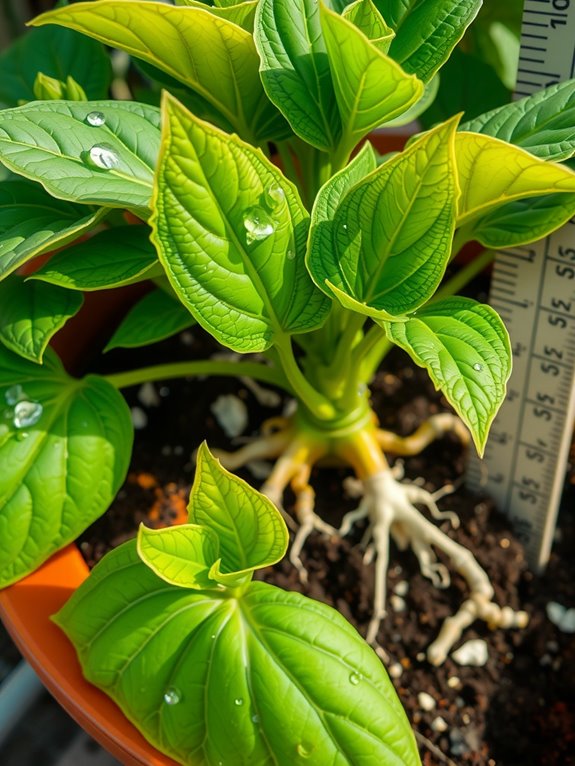
Have you noticed your container plants’ leaves turning yellow while the veins stay green? That’s magnesium deficiency, and it’s more common than you’d think in pots. Here’s what’s actually happening beneath the soil surface:
Magnesium washes out of container soil faster than it does in garden beds, simply because water drains through so quickly. Meanwhile, if your soil has excessive calcium, it raises the pH and blocks your plant’s ability to absorb the magnesium that’s still there. As the deficiency deepens, you’ll spot leaf cupping and increasingly pale yellow patches, which slows growth considerably.
The straightforward fix starts at the roots. Mix one teaspoon of Epsom salts into each gallon of water and apply this solution twice a year to container soil. Epsom salt is just magnesium sulfate, and those crystals dissolve readily to feed hungry roots.
When root absorption isn’t working well enough, skip the soil altogether and spray the leaves directly. Foliar applications bypass the root system and let magnesium absorb straight through the leaf surface, which works surprisingly fast when you need quick results.
For outdoor containers specifically, dolomitic limestone does something clever—it adds both magnesium and calcium in a balanced ratio, so you’re not accidentally creating the same pH problem you’re trying to solve. Work it into your container mix at the start of the season rather than adding it later.
The real point is this: container plants lose magnesium faster than plants in the ground, and they need regular replenishment to stay healthy and green.
Extreme Temperatures: Why Flowering and Fruit Set Fail
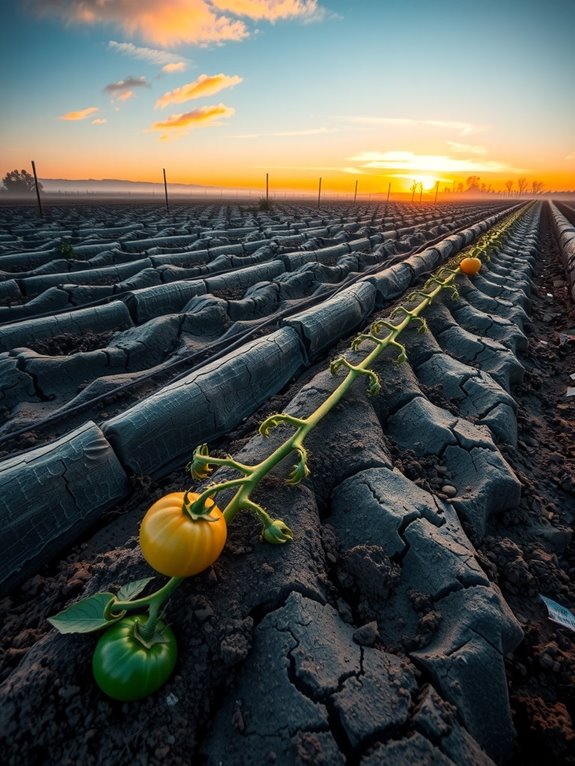
Why do your tomatoes stubbornly refuse to set fruit during a brutal heat wave, or why won’t your peach tree bloom at all after a mild winter? Extreme temperatures disrupt the delicate balance your plants need to function properly. When daytime heat soars above optimal levels, respiration overtakes photosynthesis, leaving your plants exhausted and unable to flower or set fruit.
Extreme temperatures disrupt the delicate balance plants need to function, leaving them exhausted and unable to flower or set fruit.
Temperature swings between day and night matter more than you might think. You’ll want roughly a 10–15°F difference between your warmest day and coolest night for balanced growth and flower development. This cooling period helps plants shift energy from just surviving the heat to actually reproducing through flowers and fruit.
Some plants have very specific cold requirements that seem picky but actually make biological sense. Peaches, for example, need 700–1,000 hours in the 32–45°F range to break dormancy and trigger the flowering process. Without those chilly hours, the tree stays stuck in sleep mode no matter what you do. A sudden cold snap following warm weather creates a different problem—it damages even hardy plants and tanks your fruit production by killing tender flower buds.
Understanding what your specific plants actually need temperature-wise stops the guessing game. You’ll know whether your failure comes from too much heat, not enough cold, or the temperature swings being too gentle. That knowledge lets you choose better varieties for your climate or adjust your timing for planting and care.
Light Limitations: When Photosynthesis Stalls
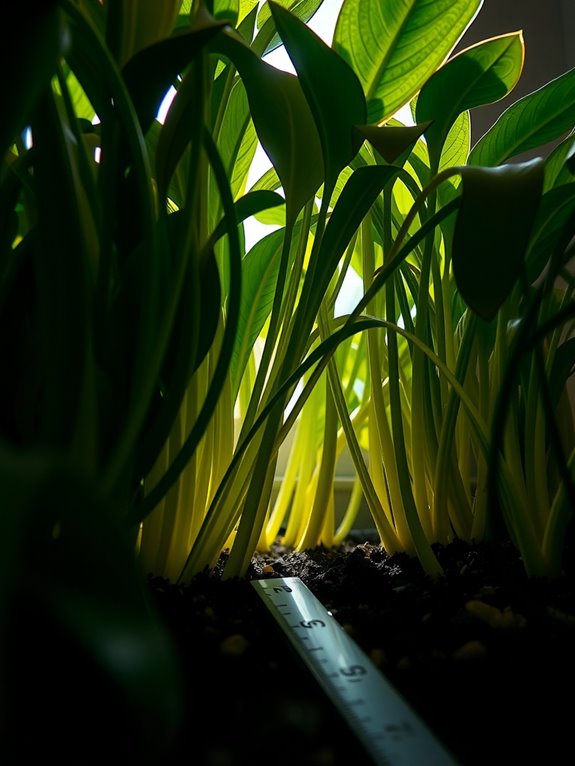
You’d be surprised how often light—not water or nutrients—becomes your plant’s real problem. Your plants need the right *amount* of light intensity to power photosynthesis, the correct photoperiod duration (those critical hours of darkness that trigger flowering), and the specific light wavelengths that match what they’re actually trying to do, whether that’s leafy growth or blooms.
Think of light intensity like the volume dial on a speaker. Most houseplants need between 200 to 600 foot-candles of light to photosynthesize efficiently, though this varies by species. A succulent sitting in direct south-facing sun might get 1,000 foot-candles, while a shade-loving fern prefers 50 to 150 foot-candles. Too little, and your plant can’t convert light into the sugars it needs for energy. Too much, and leaves can actually bleach or burn.
Then there’s photoperiod—the daily rhythm of light and dark that tells your plant when to flower. A poinsettia won’t bloom unless it gets 12 hours or fewer of light per day for several weeks straight. Tomatoes, on the other hand, flower best with 16 to 18 hours of light daily. Your plant’s flowering switch depends entirely on this timing.
Light wavelengths matter just as much. Blue light wavelengths (around 400 to 500 nanometers) push plants toward compact, bushy leafy growth. Red light (600 to 700 nanometers) promotes flowering and fruiting. Most plants actually need a blend of both—which is why full-spectrum grow bulbs work better than single-color options.
Get any of these three factors wrong, and you’ll watch your plant struggle no matter how perfect everything else looks.
Insufficient Light Intensity
Your plants need light like you need coffee in the morning—without enough, everything just slows down. When light intensity falls short, your plants can’t generate the energy they need through photosynthesis to fuel growth and metabolism.
Here’s what happens when light becomes insufficient:
Weak, spindly growth occurs as stems stretch desperately toward any available light source in a condition called etiolation. These plants end up looking pale and fragile because they’re literally reaching and straining for what they need.
Photosynthesis slows dramatically, meaning your plants produce less energy for building new leaves and roots. With reduced energy production, your plants shift into survival mode rather than focusing on growth.
To fix this, consider these practical solutions:
Boost light intensity by moving plants closer to windows that receive 12 to 16 hours of bright, indirect light daily. If natural light is limited, add supplemental grow lights positioned 6 to 12 inches above your plants’ leaves, depending on the light’s wattage. LED grow lights around 20 to 40 watts work well for small collections and use less electricity than older fluorescent models.
White or reflective backgrounds bounce available light back toward your plants, increasing the light they actually absorb. Aluminum foil, white paint, or commercial reflective panels all work effectively for this purpose.
Monitor your plants’ response over two to three weeks. When light intensity improves, you’ll notice sturdier stems, fuller leaf development, and slower, steadier growth as your plants shift back into normal functioning.
Inadequate Photoperiod Duration
Even when plants receive plenty of bright light, they’ll still refuse to flower if the daily light duration doesn’t match their genetic expectations. Your plant’s internal clock tracks photoperiod—the actual length of light and darkness each day—and this timing matters more than you’d think.
Short-day plants need fewer than 12 hours of light to trigger flowering, while long-day plants require more than that threshold. Get this timing wrong, and you’ll watch your plant grow leafy and strong yet stubbornly skip blooming altogether. It’s frustrating, but there’s a straightforward reason behind it.
The good news is that you control this completely. Adjust your plant’s daily light exposure using natural sunlight or supplemental grow lights like LED panels. Even slight timing adjustments—shifting your plant’s light schedule by an hour or two—can unlock flowering potential. Think of photoperiod as your plant’s seasonal signal. Match it correctly, and you’ll finally see those blooms you’ve been waiting for.
If you’re using artificial lighting, position LED grow lights 6 to 12 inches above your plant depending on the light’s wattage, and use a simple timer to maintain consistent daily schedules. Natural sunlight works perfectly too, though you may need to move your plant to a sunnier window or use blackout curtains to shorten light exposure for short-day plants. The key is consistency—your plant responds better to regular daily patterns than to random fluctuations.
Poor Light Quality Wavelengths
When your light quality falls short, your plants respond in pretty predictable ways:
Blue light shortage – Without enough blue wavelengths, plants stretch tall and spindly instead of growing dense and compact. They’re basically reaching upward, desperately hunting for better light conditions.
Red light deficiency – Flowering and fruiting slow way down because red light triggers the reproductive processes plants need to make those blooms and fruits happen.
Green light misconception – Plants actually reflect green wavelengths, which is why we see them as green rather than absorbing them. But full-spectrum lights do capture those missed wavelengths, giving your plants access to a more complete photosynthesis toolkit.
The practical fix involves matching your light to what you’re growing. Fluorescent cool-white bulbs work well for leafy greens since they naturally emit more blue light. If you’re after flowers, you’ll need to add red wavelengths into the mix. A 40-watt cool-white fluorescent paired with a 40-watt warm-spectrum bulb, positioned about 12 inches above your plants, gives you that balanced spectrum plants respond to. Your plants aren’t picky about having both types working together – they just need access to both colors of light for different growth stages.
Photoperiod Problems: Day Length and Flowering
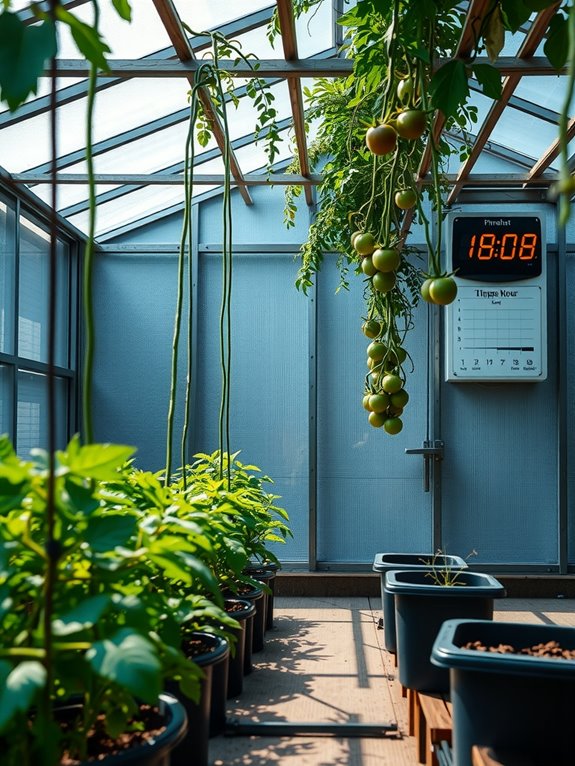
When flowers won’t show up on your plant, day length might be exactly what’s holding things back. The amount of light your plant receives each day—called photoperiod—controls flowering in many species, and getting those hours wrong stops blooms from developing. Short-day plants flower when they receive less than 12 hours of light daily, which includes chrysanthemums and poinsettias. Long-day plants need more than 12 hours of light to set buds, like lettuce and spinach varieties. Here’s what trips people up: it’s the actual light period that triggers flowering, not the length of uninterrupted darkness afterward.
The tricky part is matching your specific plant’s photoperiod needs with the right light-dark cycles in your growing space. If your chrysanthemum sits under grow lights for 14 hours instead of the 10-11 hours it needs, flowering gets delayed indefinitely. Temperature and light quality matter too—warm-spectrum bulbs around 2700K work differently than cool-spectrum ones at 6500K, and both affect when your plant decides to bloom. Once you know what your plant actually needs in terms of hours and light type, you can dial in the conditions and watch flowering actually happen.
Thermoperiod Stress: Temperature Swings Too Wide
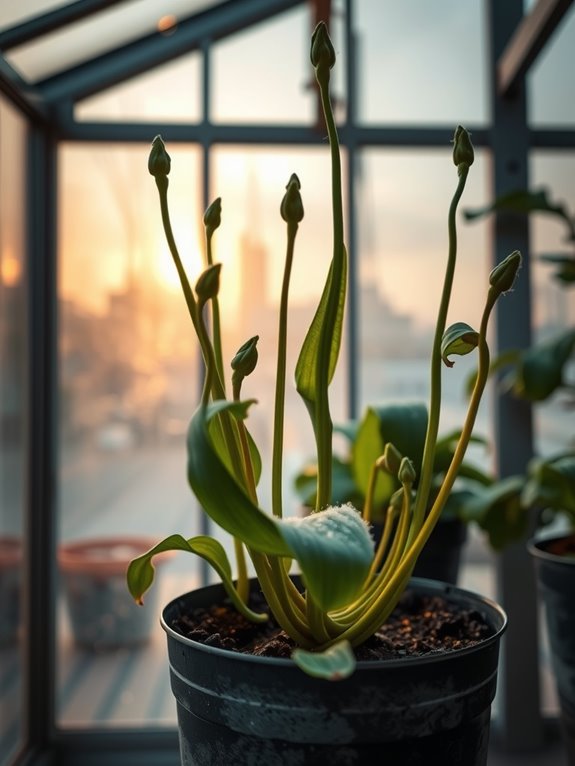
Beyond light cycles, your plants also need the right temperature rhythm to thrive—and that’s where thermoperiod comes in. Temperature swings matter because plants rely on specific day-night patterns to balance photosynthesis and respiration properly.
When daytime temperatures spike too high, respiration outpaces photosynthesis, which stunts growth and wastes your plant’s energy on heat stress instead of building new leaves and stems. Nighttime temperatures that drop too cold create a different problem: snapdragons prefer staying around 55°F while poinsettias need at least 62°F, and missing these ranges halts growth entirely.
Winter brings its own challenge with rapid temperature swings—warm spells followed by brutal cold snaps injure hardy plants, especially container-grown specimens where roots freeze before foliage does. Container plants sit above ground with exposed sides, so their root zones chill much faster than plants growing in soil beds where the earth provides insulation.
Pre-winter watering keeps plant tissues turgid and protective against freeze damage, which works because plump cells resist ice crystal formation better than shriveled ones. Think of thermoperiod as your plant’s internal clock—get the day-night temperature rhythm right, and your plants respond with steady, predictable growth.
High Soil Salinity and Root Damage
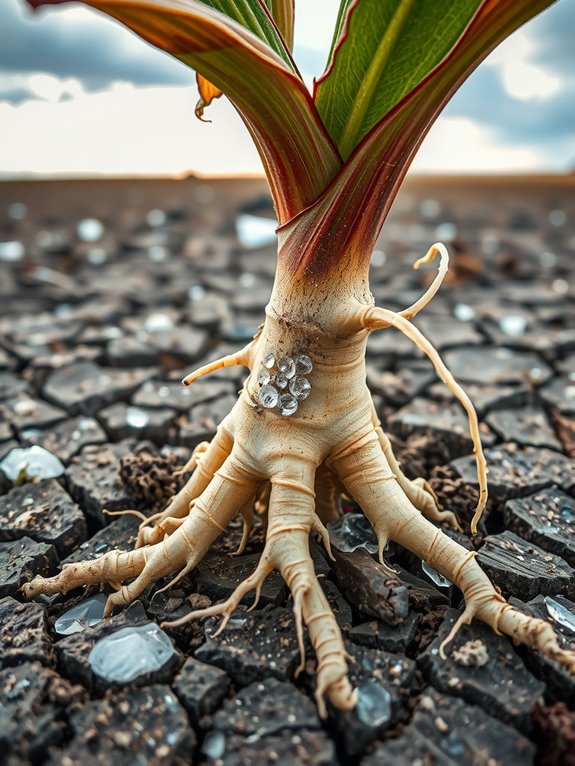
When salt builds up in your soil—from hard water, fertilizer residue, or living near the coast—it pulls water away from plant roots through osmotic pressure, even when your soil feels moist. Your plants essentially become dehydrated from the inside out.
The salt problem gets worse because these minerals compete directly with potassium and calcium for root absorption. Your plants can’t access the nutrients they need, so they starve nutritionally while sitting in fertilized soil. It’s like having a full pantry but being unable to open the door.
You’ll spot the damage pretty quickly. Leaf edges turn brown and papery, growth slows dramatically, and roots become weak and brittle rather than firm and healthy. The combination of water stress and nutrient lockout pushes plants into survival mode, where they stop growing and just try to stay alive.
To fix high salinity, flush your soil thoroughly with fresh water—use about three times the pot volume for container plants, letting water drain completely. For garden beds, water deeply and slowly so salts leach down and away from the root zone. You might need to repeat this process every few weeks depending on how salty your water source is.
Going forward, switch to lower-salt fertilizers or reduce application rates by about 25 percent. If your tap water contains high salt levels (test it if you’re unsure), consider using collected rainwater when possible. Mulching with 2 to 3 inches of compost also helps buffer salt accumulation while improving soil structure.
Salt Accumulation In Soil
How’d you like it if someone sucked the water right out of your cells?
That’s exactly what happens when salt accumulates in your soil. You’re dealing with salt stress that builds up wherever irrigation water evaporates, leaving behind harmful mineral deposits. This salt concentration damages root tips and weakens your plant’s overall vigor.
Here’s what’s happening in your soil: Salt crystals concentrate around root zones as water evaporates upward, creating osmotic stress that pulls moisture away from roots and causes severe dehydration. At the same time, micronutrient imbalances develop, triggering calcium and magnesium deficiencies that compound the problem. You’ll notice poor germination rates, stunted shoots, and leaf burn as warning signs that salt levels are climbing past safe thresholds.
Your soil salinity problem gets worse over time if left untreated. The salt buildup typically starts in the top 2 to 6 inches of soil, where evaporation is strongest, and gradually moves deeper into the root zone. Testing your soil’s electrical conductivity (EC) can tell you where you stand—readings above 2.0 dS/m indicate moderate salt stress, while readings above 4.0 dS/m signal severe problems that need immediate attention.
The good news is that salt accumulation responds well to intervention when you catch it early. Flushing your soil with fresh water, improving drainage, and switching to drip irrigation instead of overhead watering can all reduce salt levels significantly over a few weeks to months, depending on how concentrated your salts have become.
Osmotic Stress On Roots
Your roots are working overtime, and they’re losing the battle against salt buildup in the soil. When salt concentrations rise above about 2-4 millimhos per centimeter (a standard salinity measurement), osmotic stress kicks in, forcing your roots to expend massive energy just to absorb water. Even though moisture surrounds them, your roots can’t access it efficiently because water molecules move toward the salt concentration outside the root cells.
This osmotic stress directly damages root health by impairing root expansion and the formation of root hairs, those tiny finger-like structures that do the real work of water and nutrient absorption. When root hairs can’t develop properly, your plant’s foundation weakens considerably. The situation gets worse because excess salts disrupt nutrient balance by blocking the uptake of potassium, calcium, and magnesium—elements your plant desperately needs for basic functions.
Here’s where it gets serious: chronic salt stress weakens your plant’s natural defenses against pathogens and environmental challenges like temperature swings or drought. Your stunted growth isn’t laziness. It’s exhaustion from fighting a chemical battle your plant can’t win without your help.
Nutrient Uptake Disruption Effects
Your plant is stuck in a frustrating bind where nutrients sit right in the soil, but the roots simply can’t grab them. When salt levels climb too high, the soil solution becomes hypertonic—meaning it has more dissolved particles than the plant’s cell sap. This creates osmotic pressure that literally pulls water out of root cells, making it harder for roots to absorb anything at all.
The ionic imbalance hits your plant in several ways at once. Calcium and potassium absorption drops sharply, and you’ll notice leaf margins turning brown and crispy while growth slows down. Root tips take direct damage from salt crystals, which stunts root hair development and cripples the tiny structures responsible for pulling in water and nutrients. Magnesium becomes harder for the plant to access too, so leaves start cupping inward and turning yellow between the veins.
When osmotic stress clamps down on your roots, photosynthesis takes a real hit. Your plant produces less sugar and energy, leaving it vulnerable to drought stress and unable to put resources into quality fruit or vegetables. The whole system becomes a bottleneck—your roots can’t work efficiently, so your plant weakens even though everything it needs is technically available in the soil around it. Breaking this cycle means addressing the salt load itself rather than trying to add more nutrients to an already salty problem.
Poor Soil Conditions That Block Root Establishment
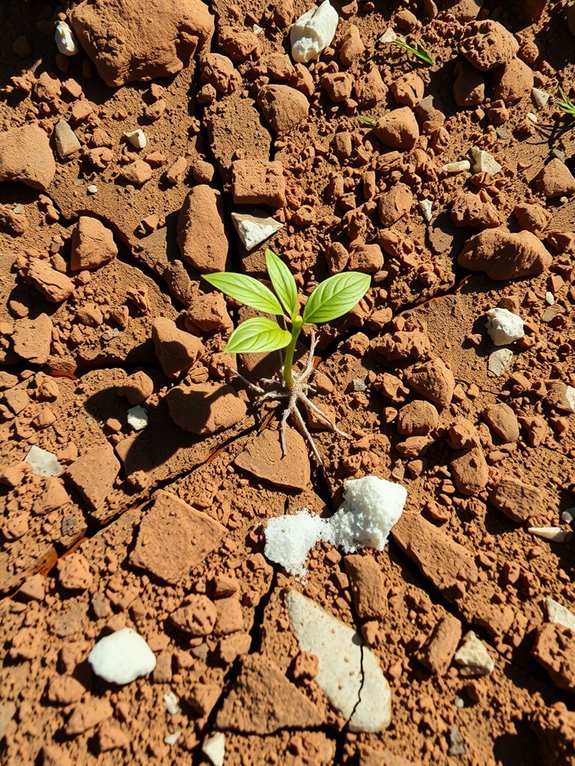
What’s happening below ground might be holding your plants back before they even get started. Poor soil conditions block root establishment by restricting water and nutrient accessibility—two things your plants absolutely need to grow properly. Compacted soil is one of the biggest problems because it squeezes out the air pockets roots depend on, reducing water infiltration and causing moisture to run off instead of soaking down where roots can reach it.
Imbalanced pH levels create another obstacle worth understanding. When your soil pH drifts too far from neutral—typically outside the 6.0 to 7.0 range—minerals like zinc and iron become locked up and unavailable to your plants, even when they’re physically present in the soil. Your plants can’t access them no matter how much you add.
Low organic matter content rounds out the problem. When your soil lacks compost, aged manure, or decomposed plant material, you’re missing the beneficial microbes that break down nutrients and improve soil structure. These microorganisms do the actual work of cycling nutrients into forms your roots can absorb.
Without these foundational conditions, your roots face too much resistance to penetrate deeply or anchor properly. The result is shallow, weak root systems that leave your plants vulnerable during their critical establishment period. Addressing these soil issues upfront prevents problems from taking hold in the first place.
Transpiration Stress in Low-Humidity Environments
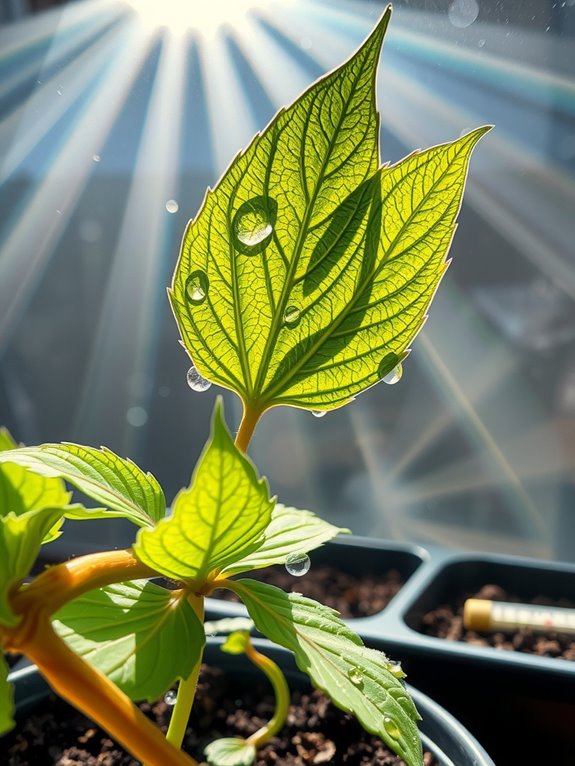
Once you’ve built a solid foundation with healthy soil, the next challenge comes from above—and it’s all about water loss. When humidity drops below 50 percent, your plants face transpiration stress as water escapes through leaf pores faster than roots can replace it. Low humidity increases vapor pressure deficit, which basically means the air is pulling moisture from leaves relentlessly, like a sponge soaking up water.
When transpiration outpaces what your plant can handle, a few things happen in quick succession. Leaves wilt and lose their firm, crisp feel because they can’t maintain turgor pressure without adequate water. At the same time, nutrient transport slows down through the plant’s vascular system, starving growing tissues of essential minerals. The plant also responds by shutting down its stomata to conserve water, which means photosynthesis drops off steeply since those same pores let in carbon dioxide needed for food production.
The practical fix involves stacking a few straightforward strategies. Raising humidity around your plants works well—you can mist leaves with water every morning, group plants together so they create their own microclimate, or place a humidifier running at 50-70 percent humidity nearby. Installing physical windbreaks with burlap or shade cloth reduces how fast moisture evaporates from leaves and soil. Adding 2 to 3 inches of mulch around plant bases also helps soil retain water longer between waterings. These steps work together to keep your plant’s water status steady and growth moving forward without requiring expensive equipment or constant fussing.
Cold Snaps and Broken Dormancy
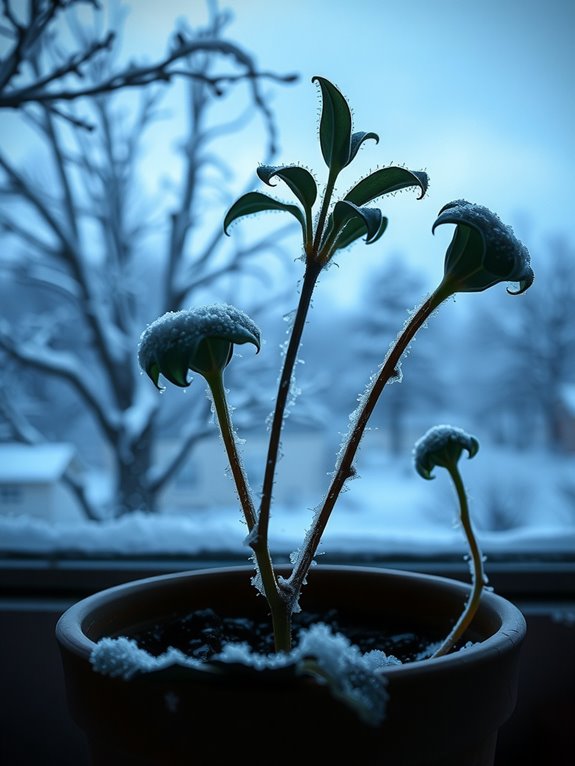
Your plants can actually suffer more from unpredictable temperature swings than from consistently cold winters. When fall temperatures drop rapidly before plants achieve full dormancy, you’re inviting serious winter injury. Then there’s the sneaky threat of midwinter warm spells—they trick your plants into breaking dormancy prematurely, leaving tender new growth vulnerable to the inevitable cold snaps that follow.
Some plants need specific cold exposure to thrive, which means those temperature fluctuations hit them especially hard. Peaches require 700 to 1,000 hours between 32°F and 45°F, while lilies demand six weeks at or below 33°F before they’ll bloom properly. That cold snap arriving after warmth does brutal damage to otherwise hardy plants, and container roots pay the price more quickly than in-ground plantings since they lack surrounding soil insulation.
The key is staying alert to those swings rather than just watching the thermometer’s low point. A week of 60°F days followed by a 15°F night will damage more buds than a steady January at 10°F. Pay attention to your local forecast, and if you see that pattern coming, consider protecting vulnerable plants with burlap, frost cloth, or even moving containers to a sheltered spot temporarily.
Diagnosing Your Plant’s Limiting Factor
Why does your tomato plant stay stunted even though you’re watering faithfully and the sun’s shining bright? You’ve likely hit a limiting factor—that one missing ingredient holding everything back.
Think of your plant like a barrel made of wooden staves. Just as water leaks out through the shortest stave, plant growth gets bottlenecked by whichever requirement falls shortest. You could have perfect light and water, but if your soil lacks nitrogen, your plant won’t budge.
Here’s how to figure out what’s actually limiting growth. Start by looking at your soil and leaves together—pale, yellowish leaves often point to nitrogen deficiency, while purple-tinged or reddish foliage suggests phosphorus running low. Check whether yellowing appears between the leaf veins or shows up mainly in the newest growth, as each pattern tells you something different about what’s missing.
Next, walk through your care routine and measure it against what tomatoes typically need. Most tomatoes want about 6-8 hours of direct sunlight daily, consistent moisture (roughly 1-2 inches per week depending on your climate), and well-draining soil with a pH between 6.0 and 6.8. Review your watering frequency, count your actual light hours, check if your container has drainage holes, and look back at when you last added fertilizer or compost.
Once you’ve identified the weakest stave, focus your effort there first. Address that single limiting factor rather than throwing resources at everything at once. You’ll see the plant respond noticeably within 2-3 weeks, which beats the slower progress you get from spreading your attention thin.
Fixing Growth Bottlenecks: A Limiting-Factor Solution Guide
Now that you’ve pinpointed what’s holding your plant back, it’s time to actually fix it. Targeting your specific limiting factor beats throwing resources at every problem.
If nitrogen’s the culprit, apply a balanced fertilizer like 10-10-10 every two weeks. The nitrogen gets absorbed fairly quickly, so regular applications keep your plant fed without overdoing it. Phosphorus shortages? Work bone meal into your soil at 2 tablespoons per square foot. Bone meal breaks down slowly, so it’ll keep feeding your roots for months.
Water stress requires adjusting your watering schedule so soil stays consistently moist but not soggy. Stick your finger about an inch into the soil—if it feels dry at that depth, it’s time to water. Poor light means moving your plant closer to a south-facing window or setting up a grow light positioned about 6-12 inches above the leaves.
The real trick is addressing that one growth bottleneck first instead of changing everything at once. When you fix just one limiting factor, you’ll actually see which solutions work and which don’t. Your plants respond noticeably—new leaves emerge fuller and stems strengthen within a few weeks. Once you’ve resolved it, you’ll know exactly what your plants needed all along.